 Written by
 Simucube has published a detailed buyer’s guide to high-end formula sim racing wheels, breaking down why the category needs its own set of rules instead of borrowing straight from GT wheel design. Choosing a formula rim isn’t the same exercise as picking a GT setup off a shelf: the rim has to be smaller, the button real estate has to be denser, and the whole package has to survive hours of full-lock inputs without ever making you second-guess a paddle shift at 300 km/h (186 mph). Here’s what actually matters before you spend real money on a direct drive wheelbase and a formula-style rim.
Why High-End Formula Wheels Matter
A formula wheel isn’t a scaled-down GT rim. It’s built around a completely different job: giving the driver instant access to every control without ever taking a hand off the wheel. In a real single-seater, and in its simracing equivalent, the driver needs to change brake bias, adjust engine maps, flash the pit limiter, and shift gears, all while cornering at the limit. That’s why formula rims pack rotary encoders, multi-way switches, and paddles into a compact shape rather than spreading controls across a larger diameter the way a road-car or GT wheel would. The tighter footprint isn’t a style choice, it’s a functional one, and it’s the starting point for everything else in this guide.
Direct Drive Wheelbases Explained
Every serious formula setup starts with the wheelbase, and at the high end that means direct drive. Instead of routing motor output through a belt or gear reduction, a direct drive base connects the motor shaft straight to the wheel. The result is force feedback with none of the backlash, friction, or dead zones that mechanical linkages introduce. You feel curb strikes, wheel slip, and load transfer with a clarity that belt- and gear-driven wheels simply can’t match.
This is why direct drive has become the default at the premium end of the market. Simucube, Fanatec, Moza Racing, Heusinkveld, Cube Controls, and Asetek SimSports all build their higher-tier products around this technology, and belt-driven systems have been pushed down into the entry and mid-range segments over the past several years as a result. If you’re buying a formula sim racing wheel setup to train or race seriously, the wheelbase decision starts and ends with direct drive.
Torque and Force Feedback: What to Look For
Torque, measured in newton-meters (Nm), is the headline spec on every wheelbase box, but raw numbers only tell part of the story. What matters more day to day is how that torque gets delivered: resolution, latency, and the quality of the underlying force feedback tuning. A base with high peak torque but poor detail reproduction feels less convincing than a slightly lower-torque unit with cleaner signal processing. For formula disciplines specifically, where cars are light and reactive, drivers value precision and responsiveness over sheer strength, since single-seaters rarely demand the brute-force self-aligning torque you’d feel fighting a heavy GT car over curbs.
Choosing a Formula-Style Wheel Rim
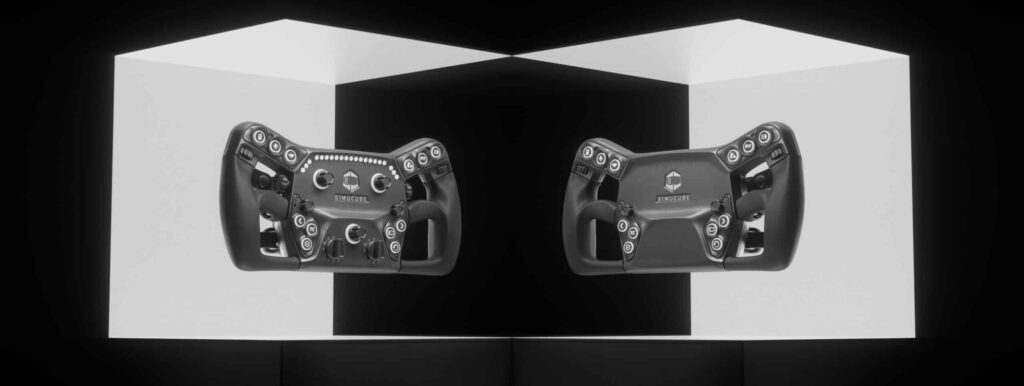
Once the wheelbase is sorted, the rim is where formula setups really diverge from everything else on the market. Two design philosophies dominate this space: Bullhorn and Butterfly. Bullhorn rims extend forward with pronounced horns that mimic the shape used in modern Formula 1 (F1) cockpits, putting shift paddles and grips further from the body. Butterfly rims are flatter and more compact, with a shape that curves inward toward the driver, favored by drivers who want the controls closer and the whole package lighter in hand.
Weight and diameter both change how the rim transmits feedback. A lighter rim lets more of the wheelbase’s detail come through, since there’s less mass damping the motor’s output, while a heavier rim smooths things out at the cost of some nuance. Diameter carries a similar trade-off: rims around 270mm (10.6 inches) feel sharper and more reactive to quick inputs, while rims in the 290-300mm (11.4-11.8 inch) range offer more stability and leverage, which some drivers prefer for longer stints. Neither approach is objectively correct; it comes down to what kind of feedback and control feel you’re chasing.
- Rim shape: Bullhorn for an F1-style layout with extended paddle reach, Butterfly for a compact, hands-close setup.
- Rim weight: Lighter for detailed, unfiltered force feedback; heavier for a smoother, more forgiving feel.
- Rim diameter: Smaller diameters for sharper reactivity, larger diameters for added stability during long runs.
- Grip material: Silicone, rubber, or polyurethane, each affecting comfort and hand fatigue over long sessions.
Ergonomics and Button Layout
Ergonomics is where formula rims either earn their premium price tag or fall short of it. Every switch, encoder, and paddle has to sit exactly where a thumb or finger expects it to be, because hesitating to find a control mid-corner costs real lap time and, in a race context, real positions. This is also where the debate between wheels with integrated displays and screen-free rims comes into play. A built-in display puts telemetry, lap timing, and radio messages directly in the driver’s eyeline, closer to what a real Formula 1 driver sees, but it adds weight, cost, and another component that can fail. A rim without a screen is lighter and often cheaper, pushing that information instead to a separate dashboard or triple-screen overlay. Grip material factors into the ergonomics equation too: silicone offers a tackier hold in hot, sweaty conditions, rubber is a durable middle ground, and polyurethane runs firmer and stays more consistent over time. None of these choices are wrong; they just suit different hands and different priorities.
Pedals and Load Cells for Formula Setups
A formula sim racing wheel and a top-tier wheelbase are only half the equation. Braking in a single-seater simulation lives or dies on the pedal set, specifically on load cell technology for the brake. Unlike a simple potentiometer that measures travel, a load cell measures the actual pressure applied, which mirrors how braking works in a real race car far more closely, especially in cars with stiff, short-travel brake pedals like formula cars. Heusinkveld is one of the names most closely associated with high-end load cell pedal sets in this space, and pairing a precise brake with a direct drive wheelbase and a properly chosen rim rounds out a setup that behaves consistently under real pressure, not just in a straight line but under trail braking and threshold conditions where formula cars are most demanding.
Top High-End Formula Wheel Setups Compared
The table below groups the main players in the high-end formula sim racing wheel space by what they’re known for, rather than by exact specs that shift between product generations. Always check current listings for the latest torque figures and pricing before buying, since manufacturers update their lineups regularly.
| Brand | Known for | Drive type | Formula rim compatibility | Quick release |
|---|---|---|---|---|
| Simucube | Precision-focused direct drive bases, wireless connectivity, LightBridge data/power transfer | Direct drive | Wide range via third-party and partner rims | Link Quick Release (wireless) |
| Fanatec | Broad ecosystem, official licensed formula wheels | Direct drive (high-end tiers) | Native licensed rims plus universal adapters | Fanatec QR |
| Moza Racing | Competitive pricing across direct drive tiers | Direct drive | Native and universal rim options | Moza QR |
| Cube Controls | Dedicated formula-style rims, Bullhorn and Butterfly designs | Rim manufacturer (base-agnostic) | Purpose-built formula rims | Universal-compatible adapters |
| Heusinkveld | Load cell pedal sets for high-end setups | Pedals, not a wheelbase brand | N/A | N/A |
Budget vs Premium: What You Actually Get
Stepping up from an entry-level belt-driven wheel to a high-end direct drive formula setup is a significant jump in cost, and it’s fair to ask what that money actually buys. The honest answer is fidelity and durability. Direct drive bases deliver cleaner, more detailed force feedback with less latency, and they’re built to handle the repeated hard inputs that formula-style racing generates without wearing out internal components the way belts and gears eventually do. Premium rims add ergonomic refinement, purpose-built button layouts, and materials chosen for long-session comfort rather than cost-cutting. None of this is essential to enjoy simracing, but for drivers training seriously or chasing consistent lap times in titles like iRacing, Assetto Corsa Competizione, or rFactor 2, the difference shows up directly in how confidently you can push the limit.
FAQ: High-End Formula Sim Racing Wheels
Do I need direct drive for formula-style racing?
It’s not mandatory, but it’s the standard at the high end because of the precision and durability it offers over belt or gear systems.
Bullhorn or Butterfly, which is better?
Neither is universally better. Bullhorn extends controls forward in a Formula 1-style layout, while Butterfly keeps everything compact and closer to the driver’s hands.
Is a display on the rim worth the extra cost?
It depends on your setup. A built-in display puts key data in your eyeline but adds weight and cost, while a screen-free rim relies on an external dashboard or monitor overlay.
What torque should I look for?
Formula cars are light and reactive, so many drivers prioritize feedback detail and responsiveness over maximum torque numbers, unlike heavier GT setups.
Do I need load cell pedals for a formula setup?
If you want braking feel that reflects how stiff, short-travel formula brake pedals actually behave, load cell technology from brands like Heusinkveld is the closest match available. Getting the pedals right is just as important as the formula sim racing wheel itself: a precise brake pedal, a well-chosen direct drive wheelbase, and a properly sized rim work together as one system, not three separate purchases. Skimping on any single part of that chain, even while spending heavily elsewhere, tends to show up exactly where it hurts most, under braking at the limit, on the exit of a hairpin, or across a long stint where fatigue starts to blur the margins between a clean lap and a mistake.
Source: simucube.com