
 Written by
 What Is the Simagic P700 Pedal Set?
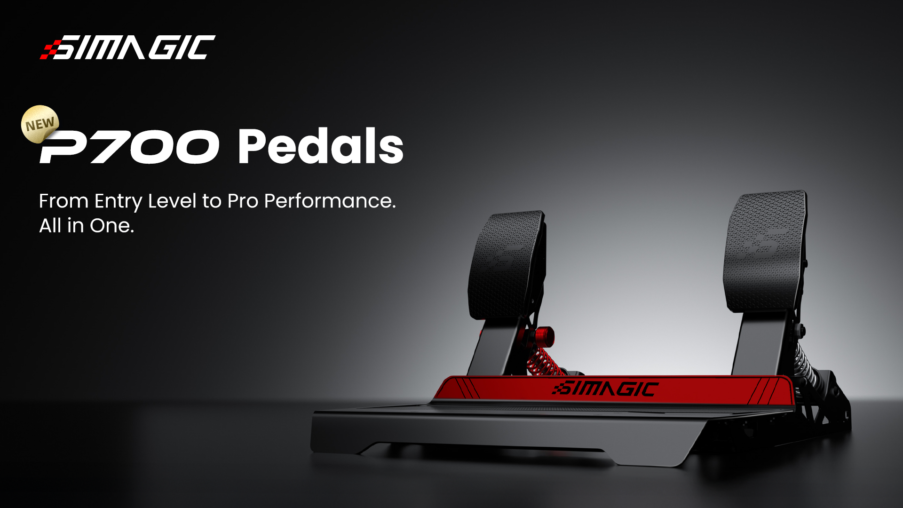
Simagic announced the Simagic P700 pedals on its official blog on March 19, 2026, adding a load cell-based pedal set below the brand’s higher-end P1000 and P2000 lines. The P700 pedal set ships in two configurations: a dual-pedal set (throttle and brake) and a three-pedal set that adds a clutch module.
The pedals bring load cell brake feel to a lower price point without cutting the features that matter most for consistent braking. Instead of a spring or elastomer brake, Simagic fitted the P700 with a load cell sensor and paired it with Hall effect sensors on the throttle and clutch — the same sensor combination the brand uses further up its pedal range.
The P700 targets simracers building a first serious pedal set or upgrading from a stock bundle that came with a wheel, filling the gap between entry-level potentiometer pedals and premium load cell units that cost several times more. If you’re weighing this against other options, our load cell pedal buying guide covers how different sensor types compare across price brackets.
Simagic P700 Key Features
The headline feature is the load cell brake, rated for up to 150 kg of input force, combined with what Simagic calls Full-Range Adaptive Sensing — a system that automatically adjusts signal gain across that entire range. The throttle and clutch pedals use Hall effect sensors instead, a reliable choice for non-braking pedals since they don’t need to measure force the way a brake does. The set is modular, so drivers can start with the two-pedal box and add the C-P700 clutch module later without replacing anything already purchased.
Load Cell Brake Technology
Load cell sensors measure force rather than pedal travel, which is why they’ve become the standard for anyone chasing consistent, repeatable braking on track. The P700’s load cell tops out at 150 kg of input, putting it in the same territory as many pedals that cost considerably more. Simagic pairs that sensor with 35 adjustable settings for the brake, letting drivers tune the feel to match their car, discipline, or personal preference. Simagic’s announcement doesn’t break down what each of the 35 settings individually controls, so buyers comparing this to the brand’s flagship pedals should confirm those specifics directly before assuming full parity.
The Full-Range Adaptive Sensing system is the part worth paying attention to. By adjusting signal gain automatically across the sensor’s range, it keeps the brake responsive whether you’re braking gently for a chicane or standing on it into a heavy braking zone, without requiring manual recalibration every time your driving style shifts.
For context, load cell sensors work by measuring the actual force applied to the pedal face rather than how far it travels, converting that pressure into an electrical signal a sim reads as brake input. This is fundamentally different from potentiometer or Hall effect brake pedals, which track travel distance instead of force and can feel inconsistent once the pedal reaches full deflection. Load cell brakes let a simracer apply the same pressure lap after lap and get the same braking result, which is why nearly every serious brake pedal on the market — from budget units to motion-rig-grade hardware — has shifted toward this sensor type over the last several years.
Hydraulic Damper System
Simagic’s higher-tier pedals are known for hydraulic damping units that shape the brake’s resistance curve, a feature many simracers associate with the brand. The P700 announcement, however, doesn’t mention a dedicated hydraulic damper assembly for this model — the brake feel here comes from the load cell sensor and its 35-position adjustability rather than a separate hydraulic component. Anyone deciding between the P700 and Simagic’s pricier pedals should confirm this directly with Simagic or a retailer rather than assume hydraulic parity with the P1000 or P2000.
Simagic P700 Pedals Specifications
Here’s what’s confirmed from the official announcement, laid out for a quick comparison:
| Spec | Detail |
|---|---|
| Brake sensor | Load cell, up to 150 kg input force |
| Brake technology | Full-Range Adaptive Sensing (automatic signal gain adjustment) |
| Brake adjustability | 35 adjustable settings |
| Throttle sensor | Hall effect |
| Clutch sensor | Hall effect (via optional C-P700 module) |
| Configuration | Modular — two-pedal set expandable to three |
| Set options | P700 dual-pedal set; P700 three-pedal set; C-P700 clutch module (standalone) |
| PC compatibility | Built for PC-based simracing setups, connecting alongside a direct drive wheel base or other wheel base hardware |
Simagic hasn’t published pedal face materials, travel distance, footprint dimensions, or weight in the P700 launch post. Those figures are worth confirming with a retailer or the brand directly if they’re a deciding factor for your rig.
Price and Where to Buy
Simagic priced the P700 lineup as follows at launch:
- P700 dual-pedal set (throttle and brake): $189
- P700 three-pedal set (throttle, brake, and clutch): $209
- C-P700 clutch module (sold separately for existing owners): $59
That modular pricing lets someone pick up the two-pedal set first and add the clutch module later for roughly the same total as buying the three-pedal set outright — a sensible way to spread out the cost if budget is tight. Pricing and stock availability can shift over time, so check current listings on Simagic’s official store or authorized retailers before ordering, especially since this launch dates back to March 2026.
Simagic P700 vs Other Load Cell Pedals
The load cell pedal category has gotten crowded, and the P700’s main selling point is bringing that sensor type down to a lower price bracket than Simagic’s own P1000 and P2000. Compared to those higher-tier Simagic pedals, the P700 trims back on some of the finer damping hardware while keeping the core load cell sensor and its adaptive sensing technology.
Against other budget-to-mid-range load cell pedals on the market, the P700’s 150 kg brake range and 35-position adjustability put it in a competitive spot on paper. The Hall effect throttle and clutch sensors are a sensible choice too, since load cell technology mainly matters on the brake pedal, where force measurement counts most.
What’s harder to judge from a manufacturer announcement alone is real-world pedal feel, long-term durability, and how the Full-Range Adaptive Sensing system performs once it’s mounted on an actual rig under race conditions. Those details only show up in hands-on testing, and independent reviews of the P700 weren’t available to draw from at the time of writing.
If you’re building out a full setup rather than just replacing pedals, it’s also worth checking pedal compatibility against your current base before buying — our direct drive wheel base guide walks through how pedals, wheel bases, and rigs typically pair up.
Pros and Cons
- Pro: Load cell brake with a 150 kg range at a price point below Simagic’s flagship pedals
- Pro: Modular design lets buyers add a clutch pedal later instead of committing upfront
- Pro: Full-Range Adaptive Sensing keeps brake response consistent across light and heavy inputs
- Pro: 35 adjustable brake settings for tuning feel
- Con: No confirmed hydraulic damper unit, unlike Simagic’s higher-tier pedals
- Con: Full technical specs (materials, dimensions, travel) aren’t published in the launch announcement
- Con: No independent reviews available yet to verify real-world brake feel
Who Should Buy the Simagic P700?
The P700 makes the most sense for simracers moving up from stock pedals bundled with a wheel or budget potentiometer sets, since load cell braking is the single biggest upgrade most drivers can make to their setup. It’s also a reasonable option for anyone already invested in a direct drive wheel base and looking for pedals that won’t feel like a mismatch in build quality.
Drivers who already own a Simagic P1000 or P2000 and want the extra hydraulic refinement those models offer probably won’t find a reason to downgrade to the P700. But for a first serious pedal set, or a second rig, the combination of a 150 kg load cell brake and modular clutch expansion at this price is worth serious consideration.
Simagic P700 FAQ
Specs & Pricing FAQs
What sensor does the Simagic P700 brake pedal use?
The brake uses a load cell sensor rated up to 150 kg of input force, paired with Simagic’s Full-Range Adaptive Sensing technology.
How much does the Simagic P700 cost?
The dual-pedal set is priced at $189, the three-pedal set at $209, and the standalone C-P700 clutch module at $59.
Can I add a clutch pedal to the P700 later?
Yes. The P700 is modular, so buyers can start with the throttle and brake set and add the C-P700 clutch module afterward.
Compatibility & Comparison FAQs
Does the Simagic P700 have a hydraulic damper?
Simagic’s official announcement doesn’t confirm a dedicated hydraulic damper unit for the P700, unlike some of the brand’s higher-tier pedal sets. Confirm this directly if hydraulic feel is a priority.
Is the Simagic P700 compatible with PC simracing titles?
The P700 offers PC compatibility as one of Simagic’s pedal products, built for PC-based simracing setups alongside a direct drive wheel base or other wheel base hardware, though full compatibility details weren’t listed in the launch announcement.
How is the P700 different from the Simagic P1000?
Both use load cell brake sensors, but the P700 sits at a lower price point and doesn’t include the same hydraulic damping hardware found on Simagic’s higher-tier pedal sets.
Source: simagic.com