
 Written by
 MOZA Flight Displays and Cockpit Panels: What’s New
MOZA Racing has announced five new products under its Flight Series, including two MOZA flight displays and an Airbus-inspired switch panel, marking the brand’s most direct push yet into flight simulation hardware. The lineup, detailed on MOZA’s official news blog, targets pilots running Microsoft Flight Simulator, DCS World, and similar titles with gear built to replicate real cockpit workflows rather than generic monitors or software overlays. For simracers who already know MOZA from its wheel and pedal lineup, this expansion signals a serious bet on flight sim hardware as a long-term category rather than a side project.
MOZA built its reputation on direct drive wheelbases, load-cell pedals, and sequential and H-pattern shifters, hardware that’s earned it a spot among the best direct drive wheelbases on the market. Over the past couple of years, the company has quietly expanded into flight simulation as well, with throttle quadrants, joysticks, and rudder pedals already available. This new wave of displays and panels pushes that effort further, moving MOZA into territory currently occupied by names like Winwing, Honeycomb, Thrustmaster, and VIRPIL.
What Is the New MOZA Flight Series
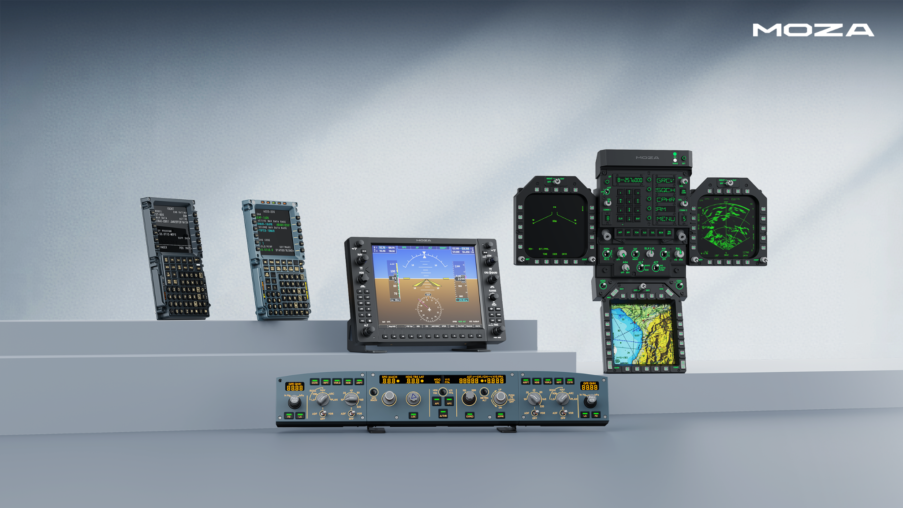
The New Gen Flight Series covers two categories: instrument displays that replicate real cockpit avionics workflows, and physical control panels with switches, encoders, and buttons for managing systems in the sim. MOZA’s stated goal is to give home cockpits the same look and function as commercial and general aviation flight decks.
Five products headline the launch:
- MA3F EFCM — an Airbus-style FCU/EFIS control module
- MA3F Flight Computer Display — Airbus-style instrument display
- MB7F Flight Computer Display — Boeing-style instrument display
- MGX1000 Instrument Panel — general aviation, G1000-style unit
- FMP18 Panel Bundle — a multi-panel accessory set
Flight Displays: Features and Design
The MA3F and MB7F Flight Computer Displays are built to mirror the layout and logic of Airbus and Boeing cockpits, respectively. Both use IPS panels housed in die-cast metal frames, a construction choice that holds up better to daily use than the plastic-bodied alternatives common in this price range. Rather than treating the display as a passive screen, MOZA designed these units to replicate the actual workflow pilots follow in those aircraft families, so switching between the two isn’t just a cosmetic change but a different operational logic.
Connectivity runs through DisplayLink technology over USB, so the displays don’t need a dedicated graphics card output to run. That’s a meaningful detail for anyone building a multi-monitor cockpit, since it frees up GPU ports that would otherwise be tied up by auxiliary screens.
Cockpit Panels: Switches and Controls
The MA3F EFCM is the standout panel in this batch. It replicates the Airbus FCU/EFIS module with a push-pull dual-rail mechanism, the same physical action pilots use to toggle between managed and selected modes on the real hardware. That level of mechanical fidelity is still relatively rare outside of dedicated Airbus-focused hardware brands, putting the MA3F EFCM in direct comparison with panels from Winwing’s Airbus lineup.
Pricing for the EFCM has been set at $149, with the MA3F and MB7F Flight Computer Displays both coming in at $199. Those numbers place MOZA competitively against established flight sim panel makers without positioning itself as a budget alternative.
Additional Cockpit Systems and Accessories
The MGX1000 Instrument Panel takes a different route, targeting general aviation rather than airliner simulation. It’s built around a 10.4-inch IPS display styled after the Garmin G1000, a glass cockpit system found in a huge range of light aircraft simulated in MSFS and X-Plane. For simmers who spend more time in a Cessna or a turboprop than an A320, this is the more directly relevant product in the lineup.
The FMP18 Panel Bundle rounds out the announcement as a multi-panel accessory set, though MOZA’s posting was light on specifics for this particular product. What’s confirmed is that it’s positioned as a bundle rather than a standalone unit, suggesting it’s meant to cover several smaller cockpit functions at once rather than replicate one specific system in depth.

Why the MOZA Flight Displays Matter for Flight Simmers
Hardware makers rarely cross over between sim racing and flight simulation successfully, mostly because the two disciplines demand very different engineering: a wheelbase needs torque and precision under load, while a flight panel needs dozens of discrete switches, encoders, and a display that behaves like real avionics. MOZA’s push into this space stands out because it’s coming from a brand with real manufacturing scale behind it, not a boutique flight sim specialist building in small batches. It’s also worth noting that MOZA’s throttle quadrants and joysticks already sit in the broader HOTAS (Hands On Throttle-And-Stick) category that anchors most serious flight sim setups, so the new displays and panels extend an ecosystem that was already partway built rather than starting one from scratch.
That scale could matter for pricing and availability over time, two areas where flight sim hardware has historically lagged behind racing gear. Winwing, Honeycomb, and VIRPIL all produce excellent products, but stock shortages and long shipping windows are common complaints in flight sim communities. Whether MOZA can avoid those same bottlenecks remains to be seen, but the company’s existing supply chain for racing peripherals, the same one behind its load-cell pedal lineup, is a reasonable point in its favor.
For simmers already invested in MOZA’s wider hardware ecosystem, from wheelbases to pedals to HOTAS controllers, there’s also an obvious appeal in staying within a single brand’s hardware and software environment rather than mixing components from three or four different manufacturers. That kind of consolidation is exactly what’s driving interest in the Flight Series before a single unit has shipped.
Put simply, MOZA entering the flight displays and cockpit panels market is a bigger deal than a routine product drop. It’s a signal that a company with proven manufacturing scale in sim racing sees enough demand in flight simulation to commit real engineering resources rather than a rebranded accessory. If MOZA can match its racing-side reliability on stock and shipping, the Flight Series could pressure established flight sim brands on price and lead times in a way boutique manufacturers simply can’t. That’s the part worth watching over the next few months, more than any single spec sheet.
Specs and Sim Compatibility at a Glance
Here’s how the five new products compare on style, connectivity, and intended use:
| Product | Style | Connectivity | Best For | Price |
|---|---|---|---|---|
| MA3F EFCM | Airbus FCU/EFIS | USB (DisplayLink) | Airbus fleets in MSFS | $149 |
| MA3F Flight Computer Display | Airbus-style avionics | USB (DisplayLink) | Airbus fleets in MSFS | $199 |
| MB7F Flight Computer Display | Boeing-style avionics | USB (DisplayLink) | Boeing fleets in MSFS | $199 |
| MGX1000 Instrument Panel | G1000-style glass cockpit | USB (DisplayLink) | General aviation in MSFS/X-Plane | Not yet listed |
| FMP18 Panel Bundle | Multi-panel switch set | USB | Auxiliary cockpit systems | Not yet listed |
All the displays share the same DisplayLink-based USB connection, which keeps installation consistent across the range whether you’re building an Airbus, Boeing, or general aviation cockpit. That consistency also means simmers switching between the MA3F and MB7F setups, or adding the MGX1000 later, won’t have to rethink their cabling or driver setup each time.
Availability, Pricing, and Release Timeline
MOZA has confirmed pricing for the MA3F EFCM and the MA3F and MB7F Flight Computer Displays but has not published a firm shipping date or full retail pricing for the MGX1000 or the FMP18 Panel Bundle. There’s also no confirmed launch window for when the full Flight Series lineup will be available to order. Simracing.Fan will update this piece once MOZA shares release dates and final pricing for the remaining products.
Frequently Asked Questions
What is the MOZA Flight Series?
It’s a new line of flight simulation hardware from MOZA Racing, covering avionics-style displays and cockpit control panels for Airbus, Boeing, and general aviation setups.
Which sims does the Flight Series support?
MOZA’s announcement points to Microsoft Flight Simulator as the primary target, with the MGX1000’s G1000-style layout also relevant for X-Plane users flying general aviation aircraft.
Do the displays need a graphics card connection?
No. All the announced displays connect via USB using DisplayLink technology, so they don’t require a dedicated GPU output.
How much do the new products cost?
The MA3F EFCM is priced at $149, while the MA3F and MB7F Flight Computer Displays are each $199. Pricing for the MGX1000 and FMP18 Panel Bundle hasn’t been announced yet.
Source: mozaracing.com