 Written by
 Simucube has published a new partnership case study exploring Simucube professional driver training, detailing how professional drivers use its direct drive wheelbases as part of their preparation programs. The piece, titled “Simucube: Trusted by Professionals,” features testimony from four drivers across different disciplines — Tatiana Calderón, Tim Heinemann, Mika Keski-Korpi, and James Baldwin — each explaining why the Finnish manufacturer’s hardware has become part of their preparation routine, both on track and off it.
The case study is notable because it moves beyond marketing language and lets the drivers describe, in their own words, how simracing hardware fits into a professional career. Calderón, who competes in top-level single-seater and endurance racing, uses her simulator setup to learn new circuits and squeeze more value out of limited on-track time. Heinemann frames the tool differently, describing simracing as something that helped shape him as a driver, not just a way to memorize corners. Keski-Korpi, who trains for drifting, points to force feedback as the piece of the puzzle that makes the practice transferable to a real car. Baldwin, meanwhile, keeps it simple: reliability is what matters most when hardware is part of a daily training routine.
Simucube Professional Driver Training: Why Pros Choose the Platform
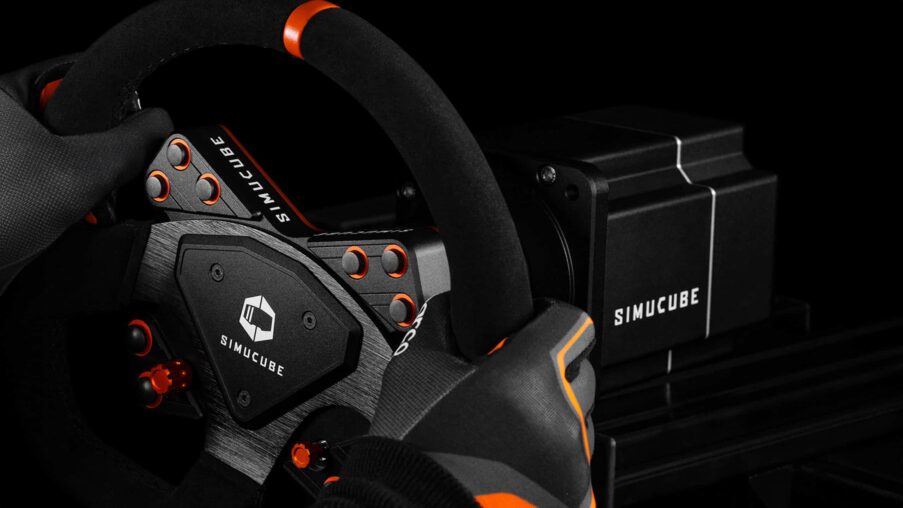
Professional racing schedules leave little room for wasted time. Track days are expensive, testing is limited, and every session on real asphalt has to count. That is where a high-fidelity simulator setup earns its place in a driver’s toolkit. A direct drive wheelbase like the Simucube 2 removes the belts, gears, and pulleys found in cheaper systems, connecting the steering wheel motor straight to the input shaft. The result is force feedback that reacts instantly and communicates the small details — a curb, a loss of grip, a weight shift under braking — that a driver needs to feel, not just see on a screen.
That level of detail is exactly what the drivers in the case study describe. Calderón’s use case is about circuit familiarization: walking into a weekend already knowing braking points and apex sequences. Heinemann’s is broader, treating the simulator as a genuine training ground for racecraft. Both depend on the same underlying requirement — feedback that is accurate enough to trust, which is the core promise behind Simucube professional driver training as a category of use rather than a marketing label.
Inside the Partnership: Case Study Highlights
Simucube built its case study around four drivers who use its hardware in very different contexts, which is part of what makes the piece worth reading. Rather than a single testimonial, it shows how one wheelbase platform serves single-seater preparation, esports-adjacent GT racing, and even drifting, a discipline where the demands on a simulator are quite different from lapping a road course.
Esports Teams Relying on Simucube
James Baldwin’s career is a useful example of how esports and real-world racing have merged. Drivers who came up through simracing competitions now race GT cars professionally, and many keep training on the same type of equipment they used to break into the sport. Baldwin’s comment in the case study is straightforward: what he values most is that the hardware simply works, session after session, without failures interrupting a training block. For a driver splitting time between esports events and real racing programs, that consistency matters as much as raw performance figures.
Motorsport Academies and Driver Programs
Tim Heinemann’s account points toward a broader trend in motorsport academies and junior driver programs, where simulators are no longer treated as a novelty but as a structured part of development. Heinemann describes the simulator as a tool that helped make him a driver, language that goes beyond simple track learning. That framing lines up with how many academy programs now use simulation: not only to prep for specific circuits, but to build race craft, consistency, and decision-making under pressure before a driver ever gets in the actual car.
Simucube Direct Drive Technology Explained
Simucube is a Finnish hardware manufacturer based in Tampere, with roots in Granite Devices, a company that built its reputation on precision motors and motion controllers before Simucube became a standalone simracing brand. That engineering background shows up in the product line: the current Simucube 2 range covers three tiers — Sport, Pro, and Ultimate — each offering a different level of torque output to match different budgets and use cases, from home enthusiasts to full professional setups. What sets the range apart for serious training use is consistency: the same force feedback behavior a driver learns on a Tuesday session should still be there on race weekend, without drift, calibration drama, or unexpected drop-off in output. That reliability is precisely what recurs across all four testimonials in the case study, regardless of discipline or budget tier.
Torque is the number most simracers focus on, and for good reason. Higher torque means the wheelbase can reproduce stronger forces without clipping, which matters when simulating heavy cars or high-grip conditions. The Simucube 2 Pro sits in the middle of the range, offering enough headroom for serious training use without the price tag of the flagship Ultimate model, which pushes torque output toward the top of what’s available in a consumer-accessible direct drive unit.
Hardware alone isn’t the whole story. Simucube pairs its wheelbases with True Drive, its configuration software, which lets drivers tune force feedback strength, filtering, and response curves. For a professional user, that tuning layer is what turns a powerful motor into a training tool that mirrors the feel of a specific car or discipline, whether that’s an open-wheel chassis or a drift car sliding through a corner.
Benefits for Aspiring and Professional Sim Racers
The case study drivers each highlight a different reason for sticking with Simucube, but their reasons overlap in a few consistent themes:
- Tactile accuracy: Direct drive removes mechanical slack, so subtle changes in grip and weight transfer come through in the wheel rather than getting lost.
- Reliability under heavy use: Professional training means daily or near-daily sessions; hardware that doesn’t need constant maintenance keeps a program on schedule.
- Discipline flexibility: The same platform supports circuit racing, endurance prep, and drifting, which matters for drivers who compete across categories.
- Software-level tuning: True Drive allows force feedback to be adjusted per car or per discipline, rather than relying on generic default settings.
- Time efficiency: Learning a track or refining car control in a simulator reduces the amount of real-world testing needed before a race weekend.
Simucube vs Other Direct Drive Wheelbases
Simucube isn’t the only manufacturer building direct drive hardware for serious simracers. Brands like Fanatec and Moza also compete in this space, each targeting slightly different segments of the market. The table below gives a general sense of where Simucube’s range sits relative to typical alternatives.
| Wheelbase Tier | Typical Torque Range | Target User |
|---|---|---|
| Simucube 2 Sport | Entry-level direct drive torque | Enthusiasts moving up from belt-driven wheels |
| Simucube 2 Pro | Mid-range, roughly 17–25 Nm depending on version | Serious simracers and professional training use |
| Simucube 2 Ultimate | High-end, around 32 Nm class | Top-tier training setups and simulator rigs |
| Competitor mid-tier options (e.g. Fanatec, Moza) | Varies by model, overlapping the Sport/Pro range | Broad enthusiast and semi-pro market |
What separates Simucube in the professional segment isn’t necessarily raw torque, since several competitors now offer comparable numbers on paper. It’s the combination of that torque with the precision engineering inherited from Granite Devices and a tuning software layer built specifically for high-fidelity feedback, which is what drivers like Baldwin and Heinemann point to when they talk about consistency and trust in daily use.
FAQ: Simucube for Professional Training
- Which Simucube wheelbase do professional drivers use? The case study confirms Tatiana Calderón trains with the Simucube 2 Pro wheelbase, paired with Simucube ActivePedal Pro pedals. Setups for the other featured drivers weren’t specified in the case study.
- Is a direct drive wheelbase necessary for serious sim racing training? It isn’t strictly required, but the drivers in this case study consistently point to force feedback accuracy as central to their training, which is the main advantage direct drive systems offer over belt or gear-driven wheels.
- Do esports drivers and real-world racers use the same simulator hardware? Based on this case study, yes. James Baldwin’s career bridges both worlds, and his training setup reflects that overlap between esports competition and professional GT racing preparation.
- Can Simucube hardware be used for disciplines other than circuit racing? Mika Keski-Korpi’s comments confirm it can. He uses Simucube’s force feedback specifically to train for drifting, a discipline that depends heavily on precise, immediate feedback from the wheel.
Source: simucube.com